
PaperComp · for care homes
It looks like paper,but it updates when it matters.
Full-colour eInk labels in the dining room, along the corridors, in the chapel. The day's menu, birthdays, activities, service times and whatever else matters come from the calendars the home already uses: they help residents feel less cut off and more part of the day, with no pointless printing and no bright, intrusive displays.
Why electronic paper
Technology that does not announce itself.
An eInk label emits no light, never blinks and asks for nothing. It hangs on the wall like a printed sheet and changes only when there is something new to say.
It reads like a printed page
No backlight and no glare: the contrast is the same from the side, against the window, and under the evening lights. Someone with weak eyesight reads what they would read on paper.
Nothing to learn
It is not a tablet and not a television: no notifications, nothing to unlock, nothing to touch. No resident has to change a habit to use it, and nobody has to explain it to them.
It draws power only when it changes
The image stays on the label with the screen off: current is needed for the moment of the update, not to keep the page lit.
Sustainable in the literal sense
Instead of sheets reprinted every day and monitors left on, there is a label that consumes almost nothing — the kind of arithmetic an ESG report can actually use.
Sizes
13.3 inches in the shared rooms, 10.1 inches in the bedrooms.
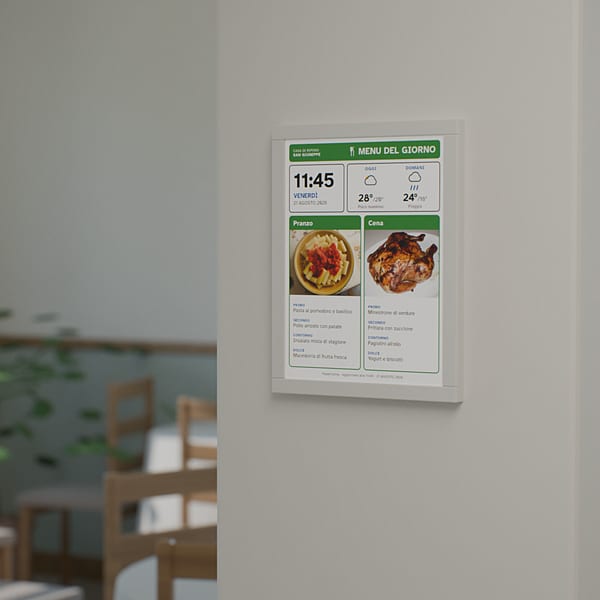
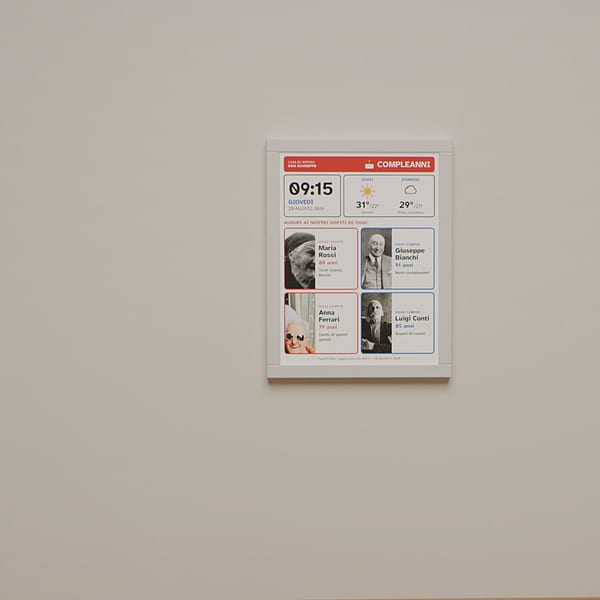
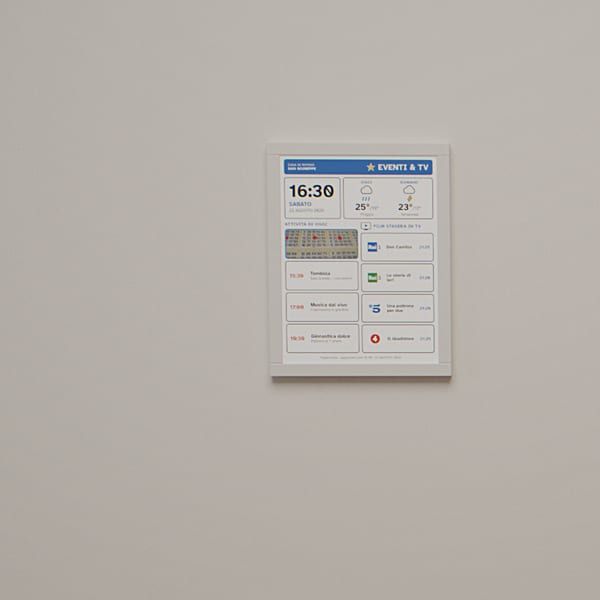
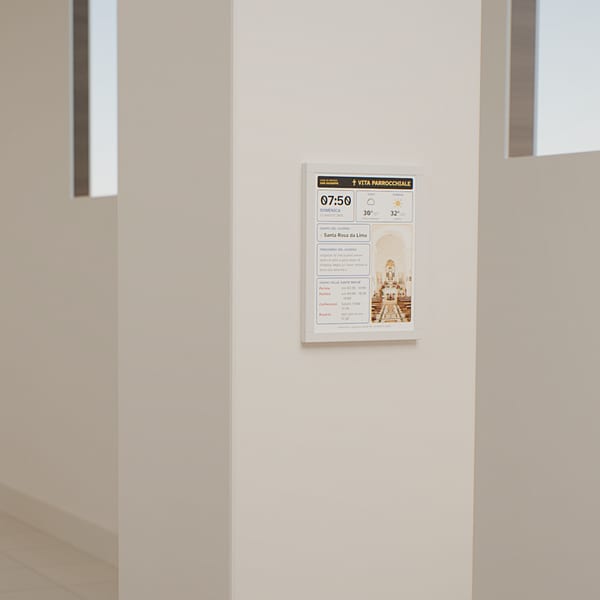
The labels in the images above are 13.3 inches: they read well without having to walk up to them.
- The shared rooms take the 13.3-inch format: dining room, corridors, entrance hall, chapel.
- Labels are organised in groups — a residential floor, a long-stay ward, the shared rooms — and each group has its own templates: you change the group, not the individual label.
In the bedrooms
A 10.1-inch label for each resident.
Same system, smaller format: outside the door, or on the table in the room.
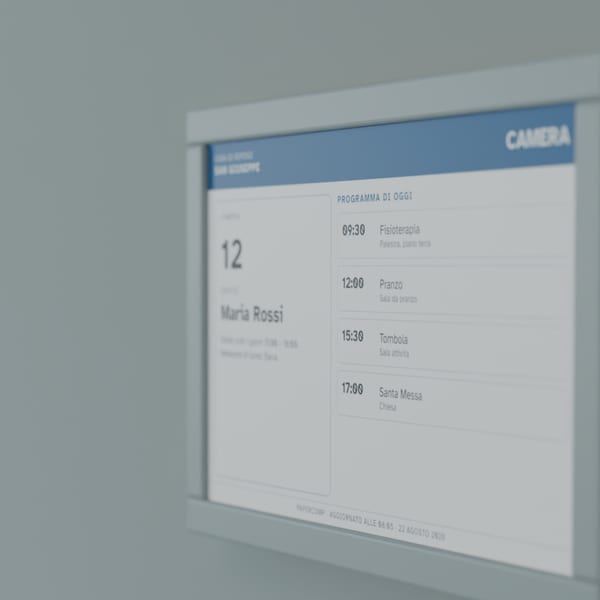
Outside the door
Who is inside, and what happens today
Beside the door the label shows the room number, the resident's name, visiting times and the day's programme.
Staff and relatives read the same information without going in and without having to ask anyone.
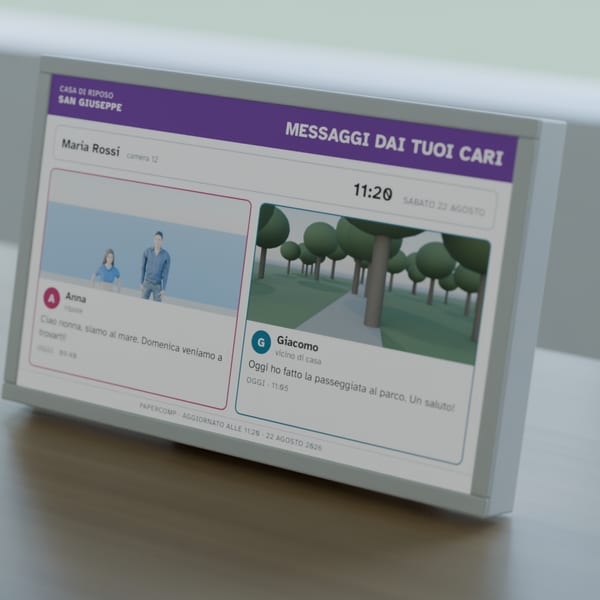
On the table
Messages from the people who love them
On the table in the room the same label shows greetings from relatives: a photograph, who wrote it and a few lines, large enough to read from a chair.
Relatives write from WhatsApp; the resident touches nothing. The notepad stays next to it — no label replaces that.
The Cockpit
One control room, even for several homes.
The Cockpit is the web application everything is managed from. It is built for the people who already run activities, the kitchen and the shift rota — not for an IT department.
Several homes, one installation
A single installation serves several care homes: each one sees its own residents, its own labels and its own content, and nothing else.
Organised by kind of information
Menus, birthdays, events, services: you pick the kind and the layout that presents it. Layouts are customisable, and new ones are added without touching the labels.
Labels in groups
Every label belongs to a group — a floor, a ward, the shared rooms — and templates are assigned to the group. One change reaches every label that should get it.
Content by email
The week's menu is sent by email, exactly as it is sent today: the system picks it up and lays it out. There is no new way of working to learn.
Content can just as well come from the calendars the home already keeps up to date.

Under evaluation
Safety
Knowing where someone is, and noticing a fall.
We are evaluating Meshtastic devices — the SenseCAP T1000-E in particular — as a safety layer alongside the labels: low cost, long range, and no cameras.
- LoRa nodes build a network of their own across the building and the garden, without depending on the home's Wi-Fi coverage.
- The device is the size of a card — 85 × 55 × 6.5 mm, 32 grams — worn on a lanyard, carried in a pocket or sewn into a jacket. That is enough to know whether a resident is in the building or has left it, without filming them.
- It carries a 3-axis accelerometer: it could recognise a fall and raise it with the staff immediately. That is exactly what we are measuring.
Real layouts
Four examples, photographed on a 13.3-inch label.
These are not mockups: they are photographs of the real label with four different layouts loaded onto it. Every kind of information has its own, and layouts are customisable.
The day's menu, lunch and dinner side by side, with a photograph of the main course. Today's birthdays, with the name, the age and a wish for each resident. Activities and appointments, in order of time. Parish life: service times and the day's feast.
All four photographs are of the same label: what changes is the layout, not the device.