
For the home
At home, with no network and no account.
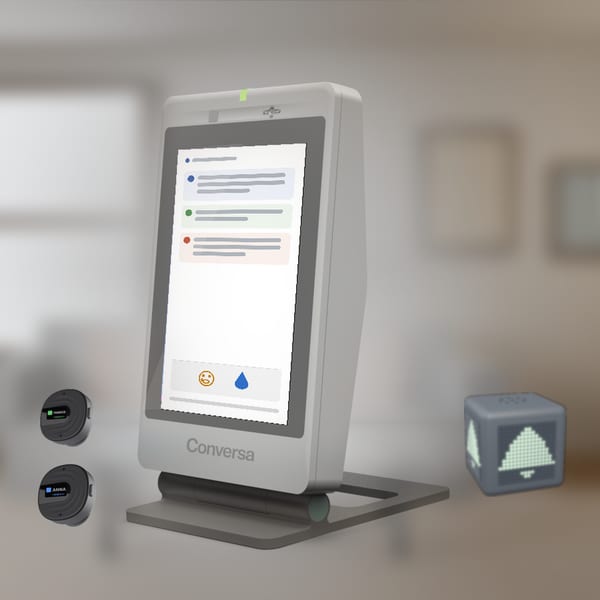
A portable, self-contained device. It assigns a colour to each voice and signals, with light, the sounds that would otherwise be missed.
In the living room, the kitchen, the garden
A conversation between several people, made readable.
The device tells the voices apart and gives each one a colour. In a conversation between three or four people there is no guessing who said what — you can see it.
RGB LEDs signal the environmental sounds that are missed most easily — the doorbell, a child crying, an alarm, running water. The colour indicates the type of sound, and the signal always comes with a description on screen.
Integrated battery, one button, no configuration. It switches on and works: there is no account to create, no network to set up, no app to pair.
Design render. The device's design is still being finalised: form, materials and interface may change.
What it does
Four things, done properly.
One colour per voice
Speaker segmentation assigns each voice a stable colour for the whole conversation.
The sounds that are missed
Doorbell, crying, alarms, running water: signalled by the LEDs and described on screen.
Self-contained
Integrated battery and a single button. It moves from room to room and keeps working.
On-board edge AI
The models run on the device itself. No Wi-Fi needed, let alone internet: no account, no login, no network to configure.
In evolution
Environmental sounds
A sensor in the room where the sound happens.
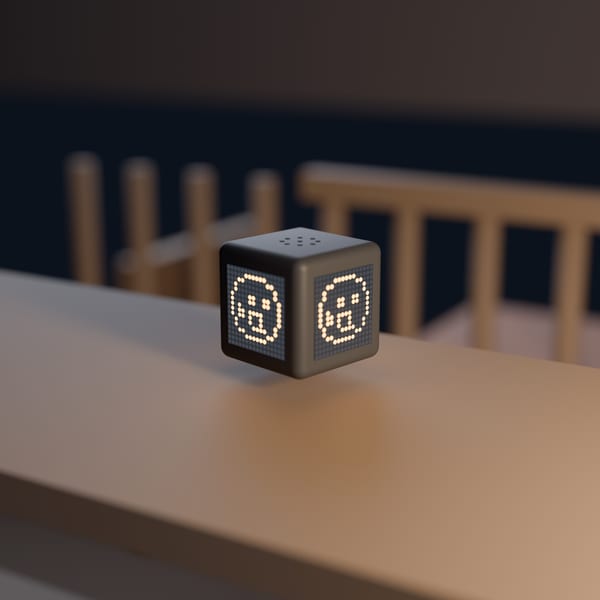
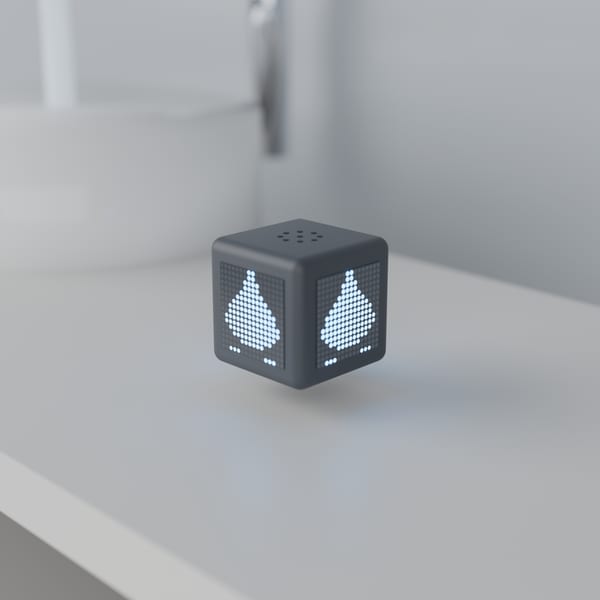
A six-centimetre cube, with no network and no account. A microcontroller recognises environmental sounds on board — ESR, environment sound recognition — and all four walls light up with the icon of the sound it heard, so it can be read from anywhere in the room.
Child's room
The child is crying
The cube recognises crying and lights the face on all four walls. It is visible from the doorway, without going in and without turning the light on.
Bathroom
Running water
A tap left running is a sound that goes unheard. The cube recognises it and shows it as a drop, in a different colour.

In evolution
Clip microphones
Eight around the table, each with their own colour.
When several people talk at once, voice alone is not enough to tell the turns apart. One clip microphone per person puts every voice on its own channel — and every channel has its colour.
- Each clip belongs to one person: its small screen holds the colour that was chosen and, if you like, the name. On the device that person's turns appear in the same colour.
- Speaker segmentation stops being guesswork: the channel already says who spoke, even when two people talk over each other or the room is noisy.
- They remain accessories. The home device works perfectly well without them: clips are added as they are needed, one at a time.
Privacy
Audio never leaves the device.
Processing happens where the conversation happens. At home: on the device, with on-board AI on the Qualcomm DragonWing platform.
It works with no network. There is no service to connect to, so there is nothing to transmit.
Not only for people with hearing loss.
It helps people with hearing loss. It also helps anyone whose first language is not the local one, anyone wearing a hearing aid in a noisy room, and anyone who needs to remember at home what they were told.